Showing posts with label Bach Wilhelm Friedemann. Show all posts

Monday, January 14, 2013

Bach & Sons: 5 Piano Concertos


"These are spirited performances. Katsaris’ crystal-clear touch […]. Quite a successful party, this CD. Pianowereld." --The Netherlands

"[...] Katsaris’s reading of Johann Christoph Friedrich’s often-edgy E-Major Concerto came as something of a revelation." --Fanfare (USA)


A tireless seeker of unfairly neglected works, Katsaris here offers an original programme on disc. This brings together for the first time five of the most beautiful concertos of the Bach family: Johann Sebastian, the famous father, and his sons: Wilhelm Friedemann, Johann Christian, Johann Christoph Friedrich and Carl Philipp Emanuel. Cyprien is here accompanied by the Echternach Festival Chamber Orchestra under the baton of the Korean Conductor Yoon K. Lee.

The pianist’s personal, disciplined approach carries the hallmark of a meticulous, inquisitive musical interpreter whose familiarity with this repertoire renders any philological squabbling irrelevant. He allows his inspiration free rein in these works, whence emerges their entire evolution, from Johann Sebastian’s rigorous polyphony to Wilhelm Friedemann’s pre-romantic development to Carl Philipp Emanuel’s robust theatricality.

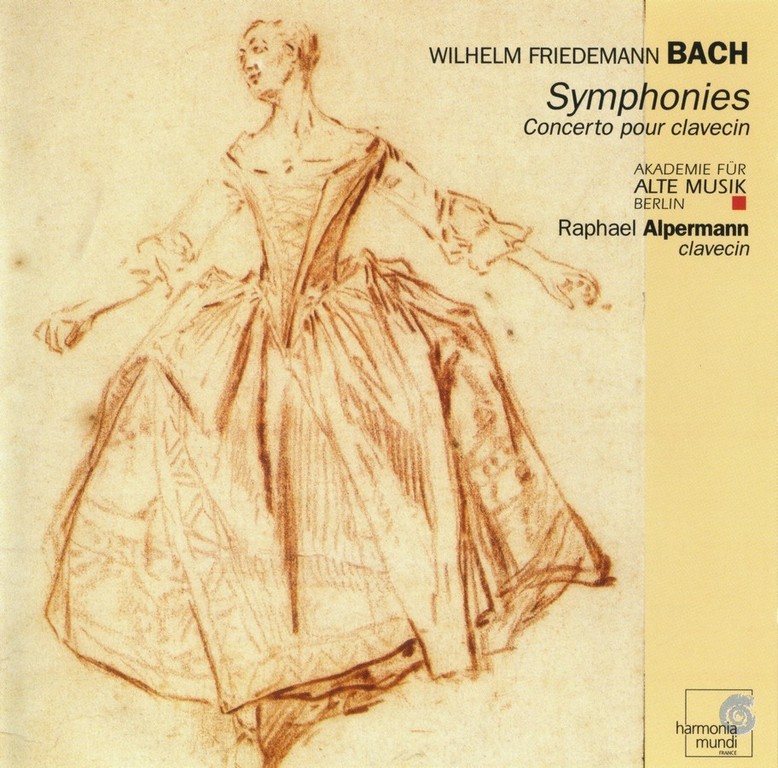


Saturday, December 29, 2012

Wilhelm F. Bach: Symphonies & Concerto pour clavecin


This recording presents a selection of works that will at last allow justice to be done to Wilhelm Friedemann Bach, Johann Sebastian's favourite son.

The legacy of his enigmatic life is a body of works whose highly personal style largely awaits rediscovery.


The eldest son of Johann Sebastian Bach, Wilhelm Friedemann was born in 1710 in Weimar and was taught by his father, after 1723, when the family moved to Leipzig, becoming a pupil at the Thomasschule. He spent four years at the University of Leipzig, before finding employment as organist at the Sophienkirche in Dresden and subsequently, with unhappy results, at the Liebfrauenkirche in Halle. 

From 1764 until his death twenty years later he held no official position, although he had been widely recognised as one of the most distinguished organists of his time and had mastered very thoroughly the lessons taught him by his father. His own tendency to the freedom of thought of the Enlightenment had not endeared him to his Pietist superiors in Halle and independence of character rendered him gradually less employable, within the restrictive circumstances of his time.


Monday, November 19, 2012

W.F. Bach: Harpsichord Concertos


It must have been daunting for J.S Bach’s musical sons to work with his huge shadow. The fact that four of his children succeeded in becoming important and influential composers is both remarkable and proof of how extraordinary these men were. C.P.E and J.C Bach are perhaps the most famous of them, and of the other two, J.C.F and W.F, it is Wilhelm Friedemann (1710-84) who perhaps came closest to his father as a composer. His compositions display the same structural density, and in particular the concerto in E flat for 2 harpsichords where many of his father’s influences can be detected, together with W.F’s use of strange dissonances and harmonic shifts.


Although he resisted the avant-garde styles of his brothers, his compositions can be appreciated as a continuation of his father’s legacy – something his brothers spent their lives fighting, whereas W.F appeared comfortable developing J.S’s methods and his own rich harmonic palette and strong melodic style. W.F’s personality was his own worst enemy. He was aloof, and unable to appreciate the views of others. He was also a terrible custodian of his father’s manuscripts – many vanished under his stewardship, and in his final years he was reduced to living in poverty and passing off some of his compositions as those of his father, leaving his wife and daughter in destitute. He was a highly gifted composer and a deeply flawed man.

Friday, November 16, 2012

La Casa del Diavolo


The last movement of Gluck's ballet Don Juan (1761), which the composer recycled 13 years later in Orphée et Eurydice, evidently made a deep impression on Mozart: the D minor tonality and the octave drops of the Commendatore's music in Don Giovanni show the extent of his indebtedness. Less well known is the symphony by Boccherini from which this recording takes its name. Here we have not only the same tonality but a chaconne which is a parody (in the technical sense) 'representing Hell and written in imitation of the one by Mr Gluck in his Stone Guest'.


Gluck and Boccherini are the bookends of a fascinating survey of music written between the 1740s and '80s to which the word 'Sensibility' can be applied. One exemplar of this style was CPE Bach: the symphony recorded here is full of passionate outbursts and swooning appoggiaturas. Similarly, the harpsichord concerto by his elder brother, Wilhelm Friedemann, contrasts fierce tuttis with gentle solos in the first movement and in the Andante, while the finale is a Prestissimo with whirlwind triplets for the soloist.

The concerto by Locatelli comprises a sequence of mostly short movements reflecting the emotions of Ariadne, abandoned on Naxos by Theseus. In his booklet-note, Giovanni Antonini provides a convincing descriptive programme (and oddly seems to imply that Bacchus and Dionysus were different gods). Locatelli uses recitative, echo effects and dramatic pauses to convey Ariadne's plight.

The performances can't be faulted: Antonini gets all the fire and fury of the music out of his players without being afraid of relaxing where appropriate. The only drawback is the excessively wide dynamic range, which forces you to choose between near-inaudibility in the soft passages and unneighbourly fortissimo in the loud ones. Heaven knows where you would find this unfashionably mixed programme in a record shop; but seek it out and you will be well rewarded. --Richard Lawrence, Gramophone